Private Surf Lessons in Coolangatta
1h 30m
From AUD $69
Coolangatta sits at the southern tip of the Gold Coast on the Queensland-New South Wales border — home to Snapper Rocks and the Quiksilver Pro, the Greenmount longboard wave, Point Danger lighthouse, and a surf-town beach culture five minutes from Gold Coast Airport.
Hi — Margot here. I write the Gold Coast pages for our team because I’ve put more bad-coffee miles down the Pacific Motorway than is medically advisable, and Coolangatta is the bit of the Gold Coast I keep recommending to friends who tell me they hate the Gold Coast. It’s the southern tip of the strip, right on the Queensland-New South Wales border, with proper surfing waves at Snapper Rocks, a beach culture that hasn’t been bulldozed into a high-rise atrium, and a small-airport precinct that quietly funnels in a lot of the people who never make it further north than Burleigh. If your idea of a Queensland beach holiday is more longboards and lifeguards than nightclubs and neon, this is your end of the coast.
What follows is the version of Coolangatta we’d give you if you asked us across a table at the surf club, with all the detail we use ourselves when we’re booking.
Coolangatta is the southernmost suburb of the Gold Coast, sitting on the actual Queensland-New South Wales state border. The border runs through the main street — literally, with a line painted across Griffith Street and a corresponding state marker near the customs house. Step across and you’re in Tweed Heads, NSW, which is a different state, a different time zone in summer (NSW observes daylight saving, Queensland doesn’t), and a different set of road and licensing rules. It’s the only place in Australia where you can walk between two states without crossing a body of water or a serious physical boundary.
The twin towns share infrastructure, beaches, a main shopping street and arguably a culture, but they’re run by two completely separate councils. We file most of our trips here under “Coolangatta” because we usually stay on the Queensland side, but the NSW half is part of every visit.
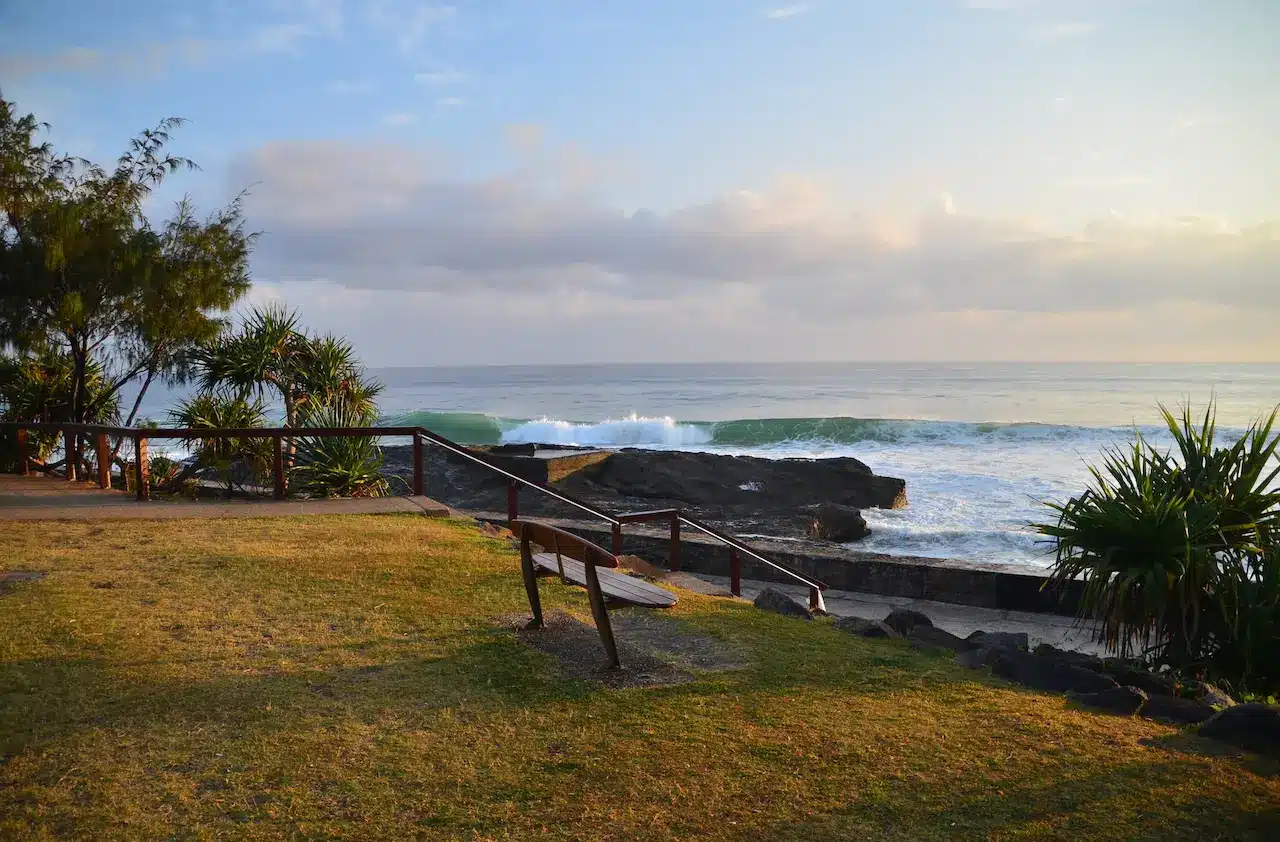
This is where Coolangatta earns its reputation. Snapper Rocks, at the southern end of Rainbow Bay, is one of the best right-hand point breaks in Australia and arguably the world. It’s the home of the Quiksilver Pro, which usually runs in March or April as the opening event of the World Surf League season, and pulls in the top tier of professional surfers and a sizeable spectator crowd. If you’re planning a visit and want to watch the comp, it’s a free spectator event — we’ve sat on the rocks above the break and watched the heats from a very good vantage point with a packed lunch.
Just around the corner, Greenmount Point holds one of the best longboard waves in Queensland. The wave breaks slower than Snapper, the ride is long, and on a clean swell you’ll see longboarders trading off down the point in an almost choreographed line. Rainbow Bay sits between Snapper and Greenmount and is the patrolled family beach — this is where you’d swim with kids, not where you’d try to learn to surf. We’ve done that. It does not end well.
If you’re a beginner, Coolangatta Beach proper (the long sandy beach on the Queensland side that runs around to Kirra) is where the surf schools operate, with gentler beach breaks and patrolled flags through summer.
The Point Danger headland sits at the easternmost point of the Queensland coast, with the Captain Cook Memorial Lighthouse at its tip. Cook named the headland in 1770 after almost putting the Endeavour on the rocks below it. The lookout is free, the view runs north along the Gold Coast skyline and south into northern New South Wales, and there’s a state-border monument right at the top that’s an unavoidable photograph. Whale-watching here is excellent in winter — the migration runs directly past the headland from June through October.
The walk from the lookout down to Rainbow Bay and around the rocks to Snapper takes about twenty minutes at a stroll and is one of our favourite short walks on the entire Gold Coast.
If Snapper gets the headlines, Kirra Beach gets the loyalty. Kirra is the next beach north of Coolangatta, with a parkland strip behind it that runs almost the full length of the sand, a surf club, and a wave that’s historically been one of the heaviest in the country. The wave has been kinder some years than others depending on sand movement (a long story involving the Tweed River sand bypass system), but on the right swell Kirra is still as good as anywhere on the east coast. It’s also a perfectly lovely place to read a book on the grass and pretend you came here just to swim.
From Kirra you can walk all the way around the coastal pathway back to Snapper without leaving the beach for more than a few seconds. Our standard Coolangatta evening: walk Kirra to Snapper, beer at Rainbow Bay Surf Club, dinner somewhere on Marine Parade. Done.
Gold Coast Airport (code OOL) is technically in Bilinga, the next suburb north of Kirra, but the whole airport precinct is part of the wider Coolangatta scene. The airport runway actually crosses the Queensland-NSW border — one end is in Queensland, the other end is in NSW. It’s one of the busiest domestic airports in the country, with direct international services to Asia and New Zealand. If you’re flying in, you’re about a five-minute drive from the Coolangatta beachfront, which is the fastest airport-to-beach experience anywhere in Australia we’ve tested. Operational info and live flights live on the Gold Coast Airport site — useful to bookmark.
That proximity is why a lot of southern visitors who book the Gold Coast for the first time end up loving Coolangatta and resenting the high-rise strip further north. You’re at the beach before you’ve unzipped your bag.
Coolangatta’s food scene is genuine surf-town casual — cafes along Marine Parade and Griffith Street, a clutch of good Asian options, fish and chips outlets that have been around long enough to have generations of customers, and the surf clubs themselves (Rainbow Bay, Coolangatta and Kirra) which all do solid bistro food with the unbeatable feature of an ocean view. The Greenmount and Coolangatta surf club at Marine Parade is the institutional choice and we’ve had a lot of unremarkable-but-perfect lunches there.
For a step up, the Tweed Heads side of the border has a couple of good restaurants on the water at Jack Evans Boat Harbour that we’d cross the state line for. Walk over, eat dinner, walk back. The border doesn’t mind.
Coolangatta is mostly mid-rise apartment towers along Marine Parade and a quieter spread of holiday apartments and family motels through Rainbow Bay and Kirra. The closer to the beachfront you are, the more you pay, but unlike Surfers Paradise the buildings are mostly four-to-twelve storeys rather than skyscrapers, so the strip still feels open and breezy.
For families, Rainbow Bay and Kirra are our usual recommendations — patrolled swimming, less car traffic, easy walking to either beach or village. For surfers, the side streets behind Snapper put you within rolling-out-of-bed range of the wave. For travellers on a budget, the area around Coolangatta Hotel and the railway-bus interchange has the cheaper end of the market and is still walkable to everything.
Northwards, the rest of the Gold Coast is your oyster. Burleigh Heads, with its national-park headland walk and the genuinely good food strip on James Street, is fifteen minutes north and one of the best half-day outings on the coast — see our broader Gold Coast guide. Surfers Paradise is around thirty minutes and is the place to put on your itinerary if only to compare and contrast (you’ll appreciate Coolangatta more when you come back).
Inland, the Gold Coast Hinterland — Lamington, Springbrook, Natural Bridge — is about an hour’s drive and a totally different environment of rainforest, waterfalls and lookouts. We treat it as a one-day-each-trip non-negotiable. Going south into northern New South Wales, Byron Bay is around 45 minutes; the Tweed Valley hinterland with Mount Warning (Wollumbin) on the horizon is one of the most beautiful drives on the east coast and a half-day well spent.
For a city day, our Brisbane guide is about an hour and a quarter north on the Pacific Motorway and gives you a complete change of pace.
The Gold Coast tram doesn’t (yet) extend to Coolangatta — current proposals have it heading down here in stages, but it stops at Burleigh Heads for now. From Coolangatta you’re reliant on the bus network, walking, ride-share, or a hire car. The bus network is honestly fine for in-town and runs all the way up to Surfers, but for anything off the coastal strip a car is much faster.
Parking around Marine Parade is paid and increasingly contested in summer — if you’re staying with on-site parking, use it and walk. Beach conditions and patrol times are published daily by the Australian Lifeguard Service and the local City of Gold Coast — both are worth bookmarking if you’ve got swimmers in the group.
The Gold Coast is a year-round destination but Coolangatta has clear shoulder-season magic. March, around the Quiksilver Pro, is one of our favourite times to be down here — the surf is firing, the weather is still warm but not Queensland-humid, and the events scene has a buzz. April through May is the peak of the dry-warm window; the water’s still swimmable, the days are clear, and the crowds have eased after the school holidays.
Winter (June through August) is cooler but still mild, dry, and excellent for whale-watching from Point Danger. Summer (December to February) is the busiest period — warm seas, school holidays, packed beaches. We avoid the Christmas-New Year week if we can help it, but the rest of summer is fine if you book ahead.
Coolangatta is the rare bit of the Gold Coast where the original surf-town atmosphere still wins. The waves are world-class. The walks between beaches are short and the views are big. The airport is so close you can be in the water within an hour of landing. The food is unfussy. The locals are sun-bleached and friendly. And every time we’re back, the place reminds us that the Gold Coast was a surf coast long before it was a high-rise coast — and that down here on the border, it still mostly is.
Live forecast from Open-Meteo. Updated each time the page loads.
Based on 30 years of weather data. Sweet spot: Aug, Sep, Nov — mild temperatures, low rainfall and plenty of sun. Avoid Feb, Mar if you can — typically the wettest or hottest stretch of the year.
Typical wave height around 1.4 m over the next two weeks. a wetsuit makes winter swims much more pleasant.
Browse every guide, listing and how-to for Coolangatta.